By Dawn Browning | Nervous System Health | Conscious Breathing | Mind-Body Wellness

Can't stop thinking about work at night? The reason isn't weak boundaries.
Your brain never got the signal the day is over. Here's the science, and the fix.
You're halfway through dinner before you realize you haven't tasted a single bite, because you're replaying that sticky conversation with a team member.
You're walking the dog, mentally running tomorrow's meeting.
By the time your head hits the pillow, you've logged three more hours of work with the laptop closed, just by thinking about it.
If you can't stop thinking about work, it probably isn't a discipline problem.
It's a signaling problem. Your brain never received the signal that work is over, so it keeps all the tabs open.
The fastest way to send that signal is simple and it's not a productivity “hack” or stern talk with yourself; it's scent.
In this article, we cover:
- why your evenings keep getting hijacked
- what's happening in your nervous system when they do
- a three-minute practice to tell your brain the day is done
Prefer to watch? In this video, I walk you through why your brain keeps working after you've stopped, and the surprisingly simple signal that can help you switch gears.
Why does my brain keep replaying work when I'm off the clock?
Your brain replays work likely because the task never got marked “closed,” not because your boundaries are weak.
Unfinished work stays mentally active, a pattern psychologists call the Zeigarnik effect, and willpower doesn't quiet it directly.
We may tell ourselves the fix is better boundaries, or that we just need to stop overthinking, as if that were as simple as saying so. But there's an underlying mistake in all of it.
We are trying to solve a psychological problem with more thinking.
That's the real cost. The biggest cost of work isn't the hours at the office. It's all the evening, weekend, and dinner-table time your brain keeps working after work is finished, and your nervous system that stays switched on.
What's actually happening in your nervous system after work?
After a demanding day, your sympathetic nervous system (the “go, go, go” branch that runs fight-or-flight) remains engaged and dominates our nervous system responses, which is why telling yourself to relax rarely works.
Relaxation isn't a decision. It's a physiological shift.
One measurable sign of that shift is heart rate variability, or HRV, the small beat-to-beat changes in your heart rate that reflect how flexibly your nervous system moves between effort and rest. Higher HRV tends to track with a calmer, more adaptable state.
The good news is that you can nudge it on purpose.
In a 2021 study in Scientific Reports led by Valentin Magnon, five minutes of deep, slow breathing five minutes of slow breathing raised parasympathetic (rest-and-recover) activity and lowered anxiety. Making the exhale longer than the inhale is what does the heavy lifting.
Why is smell the fastest off-switch for your brain?
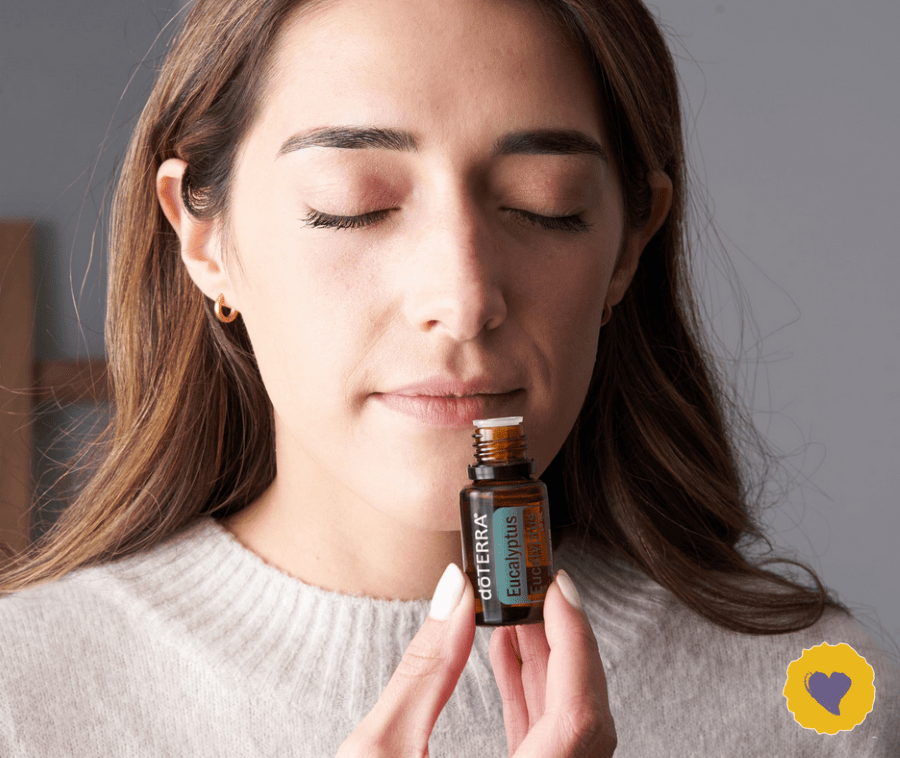
Smell is the fastest off-switch because it's the only sense with a direct line to your brain's emotional control center (the amygdala).
Odor (or aroma) signals skip the thalamus, the relay station every other sense passes through, and land straight in the limbic system.
The limbic system comprises the amygdala and hippocampus, the regions that run emotion and memory.
As Harvard researchers describe it, smell's direct route to the limbic system before you've even named it.
You already know this in your body and your mind:
- the smell of apple pie, and you're thinking of your grandmother.
- pipe tobacco, and there's your grandfather.
- citrus, and it's that summer in Florida as a teen-ager.
Smell is also the first sense we develop in the womb; we know the scent of our mother before any other sensing capacities develop. That is how deep this wiring between aroma and attention runs.
Can you really retrain your brain to end the workday?
Yes. Your brain is trainable, and you aren't stuck in this pattern forever.
Scent is one of the most direct tools for building a new association, because the olfactory system is unusually plastic (i.e., it's highly responsive to training).
Deliberate, repeated use of aroma changes the brain physically. In a 2019 study, six weeks of daily olfactory training increased cortical thickness in the brain's smell-processing regions in healthy adults.
The same pattern shows up in the professionals: perfumers and sommeliers have measurably denser gray matter in the smell-processing area of the brain.
So when you pair one specific aroma with the end (or start) of your workday, again and again, you're not just lighting a candle.
You're laying down a pathway that says “work closes here, and the rest of my day is mine.”
It's worth knowing the difference between breathwork and pranayama as you build the breathing half of that practice.
How do you stop thinking about work at night? A three-minute ritual
To stop thinking about work at night, pair one consistent scent with a few slow breaths at the same moment each day.
Consistency builds the association, not the length of the practice.
Here's the ritual.
- Pick one aroma you'll use only for this transition, so it stays specific to “work is done.” A grounding tree resin, or a calming note like Roman chamomile works well.
- Then, as you smell it, take five slow breaths with the exhale longer than the inhale, the pattern shown to raise vagal tone.
- See more details on simple breathing patterns for stress to learn how breathing works to curb stress signals.
Anchor it to the same daily cue: closing the laptop, stepping out of the car, or crossing your doorway.
Same scent, same breath, same moment. That repetition is what teaches your brain to let the day go.
You can experiment with my Steady State Reset for the moments you notice your energy needs to settle. Free, and yours to keep when you join my weekly newsletter…
FAQs about switching off after work
Q: How do I stop thinking about work at night?
A: Give your brain a signal that the day is over instead of forcing the thoughts away. Pair one specific scent with a few slow, long-exhale breaths at the same moment each evening. Repeated daily, this becomes a cue your brain reads as “work is closed.”
Q: Why can't I stop thinking about work even when I'm exhausted?
A: Exhaustion isn't the same as a nervous-system shift. A demanding day leaves your sympathetic “go” branch dominant, and unfinished tasks stay mentally active. Your brain keeps the loop open until it gets a clear signal that the workday has actually ended.
Q: Does smell really affect your mood and stress?
A: Yes. Smell is the only sense that reaches the brain's emotional center, the limbic system, without first passing through the thalamus. That direct route is why an aroma can shift your emotional state quickly, which is what makes it useful for marking the end of the workday.
Q: What's the best scent to help me relax after work?
A: The best scent is one you reserve only for this transition, so it stays linked to “work is done.” Many people reach for grounding tree resins or calming notes like Roman chamomile or lavender, but consistency matters more than the specific oil you choose
Q: How long does it take to retrain my brain to relax after work?
A: You may feel a shift the first time, since scent acts fast. The lasting association builds with repetition. Research on olfactory training shows measurable brain changes over about six weeks of daily practice, so treat it as a short daily habit rather than a one-time fix.